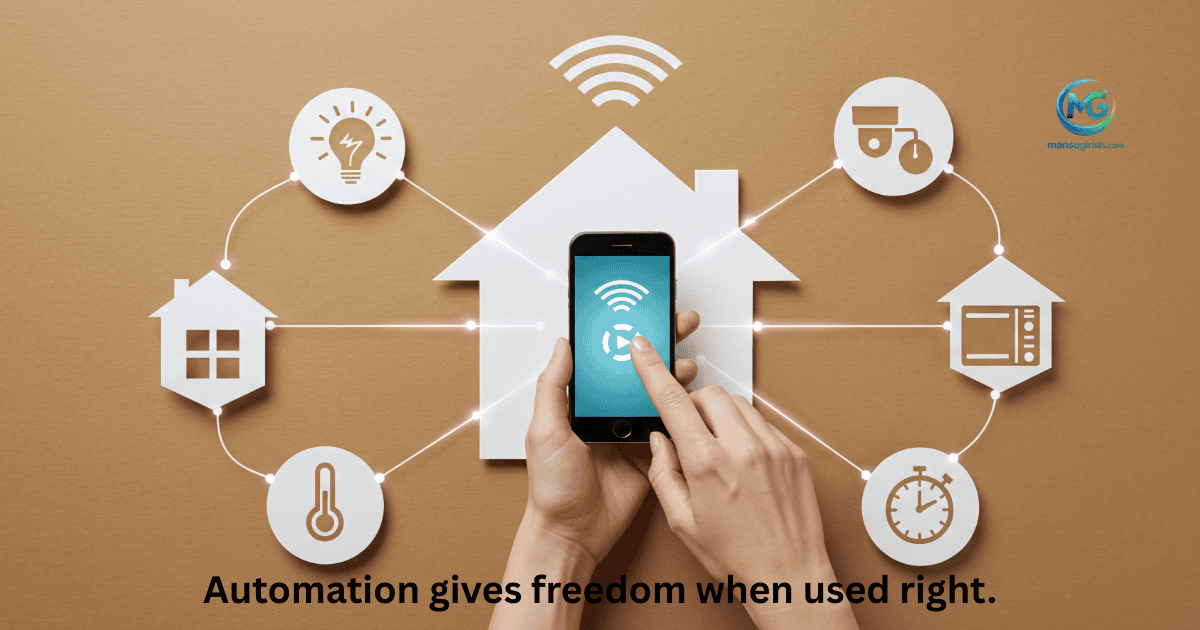
Automation is often sold as a shortcut to freedom.
“Automate this.”
“Set it once.”
“Earn while you sleep.”
But automation doesn’t automatically create freedom.
Used wrongly, automation creates chaos.
Used correctly, automation creates leverage.
After years of working online, one thing is clear:
Automation gives freedom only when systems already exist.
Why Automation Feels Like Freedom (At First)
Automation promises relief:
-
Less manual work
-
Faster execution
-
Fewer repetitive tasks
For people overwhelmed by daily effort, automation feels like the answer.
But many people automate before they understand what they’re automating.
That’s where problems begin.
Automation Without Clarity Creates Problems
When automation is used without clarity:
-
Mistakes get repeated faster
-
Poor processes scale
-
Confusion multiplies
-
Quality drops silently
Automation doesn’t fix broken systems.
It amplifies them.
If a process doesn’t work manually,
automating it only makes it fail faster.
What Automation Is Actually Meant For
Automation is meant to:
-
Save time on repetitive tasks
-
Reduce human error
-
Increase consistency
-
Free mental energy for decision-making
It is not meant to:
-
Replace thinking
-
Replace skills
-
Replace accountability
-
Replace learning
Automation supports good systems.
It exposes bad ones.
Where Automation Truly Creates Freedom
Automation works best after:
-
You understand the workflow clearly
-
You’ve done the task manually many times
-
You know where time is wasted
-
You know what must never be automated
Examples of healthy automation:
-
Posting scheduled content after strategy is set
-
Automating follow-ups after human interaction
-
Systemizing reports after knowing what metrics matter
-
Streamlining tasks that are already predictable
Freedom comes from intentional automation, not blind automation.
Why Professionals Automate Less Than You Think
Experienced people don’t automate everything.
They automate selectively.
They know:
-
Some tasks need human judgment
-
Some decisions should never be automated
-
Over-automation creates dependency
That’s why professionals often have:
-
Simple systems
-
Fewer tools
-
Clear workflows
Automation is used to protect focus, not eliminate effort.
Automation Is a Multiplier, Not a Shortcut
Automation multiplies:
-
Clarity
-
Discipline
-
Consistency
It does not multiply:
-
Motivation
-
Direction
-
Skill
If clarity is missing, automation magnifies confusion.
If clarity exists, automation unlocks freedom.
Final Thought
Automation does not give freedom by default.
Freedom comes when:
-
You understand the process
-
You build systems manually first
-
You automate with intention
-
You stay in control
Used right, automation saves time and mental energy.
Used wrong, it creates silent problems.