Landing Page vs Website: What Does Your Business Need in 2026?
When planning an online presence for your business, one important question comes up: Should you build a complete website or start with a landing page?
Both options can help businesses attract customers, generate enquiries, and promote services. However, they serve different purposes.
A website gives visitors a broader understanding of your business, while a landing page focuses on a specific offer or action.
Choosing the wrong option can lead to unnecessary development costs, confusing navigation, or missed business opportunities.
In this guide, we’ll explain the difference between a landing page and a website, when to use each, and how to choose the right solution for your business in 2026.
What Is a Website?
A website is a collection of connected web pages that provide information about a business, its products, services, and activities.
A typical business website may include:
Home
About Us
Services
Individual Service Pages
Portfolio
Testimonials
Blog
Contact
Each page serves a different purpose and helps visitors explore the business.
For example, a web development company may have separate pages for WordPress development, eCommerce development, website redesign, SEO, and maintenance.
A website gives potential customers multiple ways to understand your expertise and decide whether they want to work with you.
What Is a Landing Page?
A landing page is a standalone web page designed around a specific marketing goal.
Unlike a general business website, a landing page usually focuses on one primary action.
Examples include:
Request a Free Consultation
Download an eBook
Register for a Webinar
Get a Website Design Quote
Book an Appointment
Purchase a Product
A landing page typically removes unnecessary distractions and guides visitors toward a clear next step.
For example, if you’re running a Google Ads campaign for WordPress website development, you could send visitors to a dedicated landing page explaining that service instead of sending everyone to your homepage.
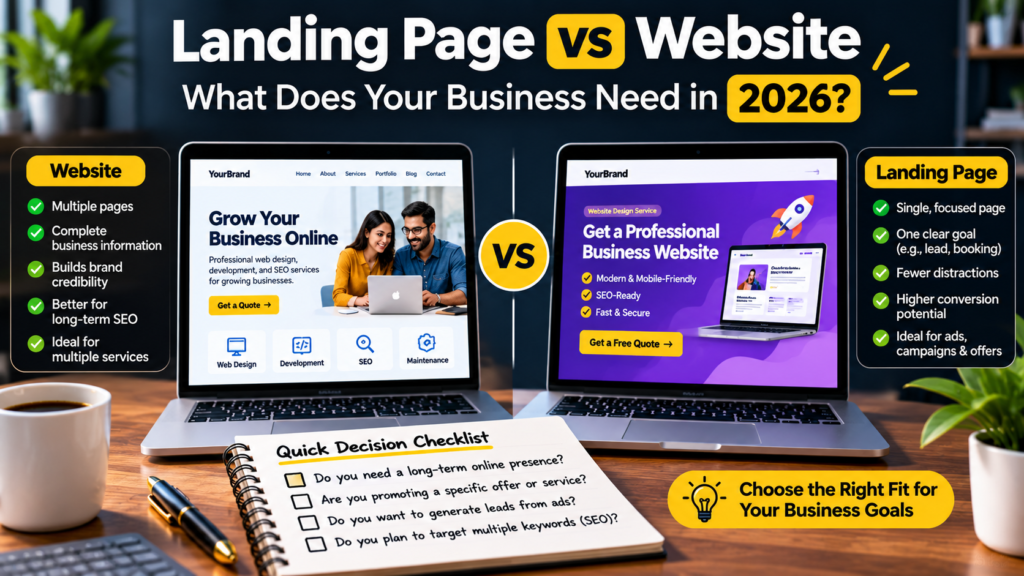
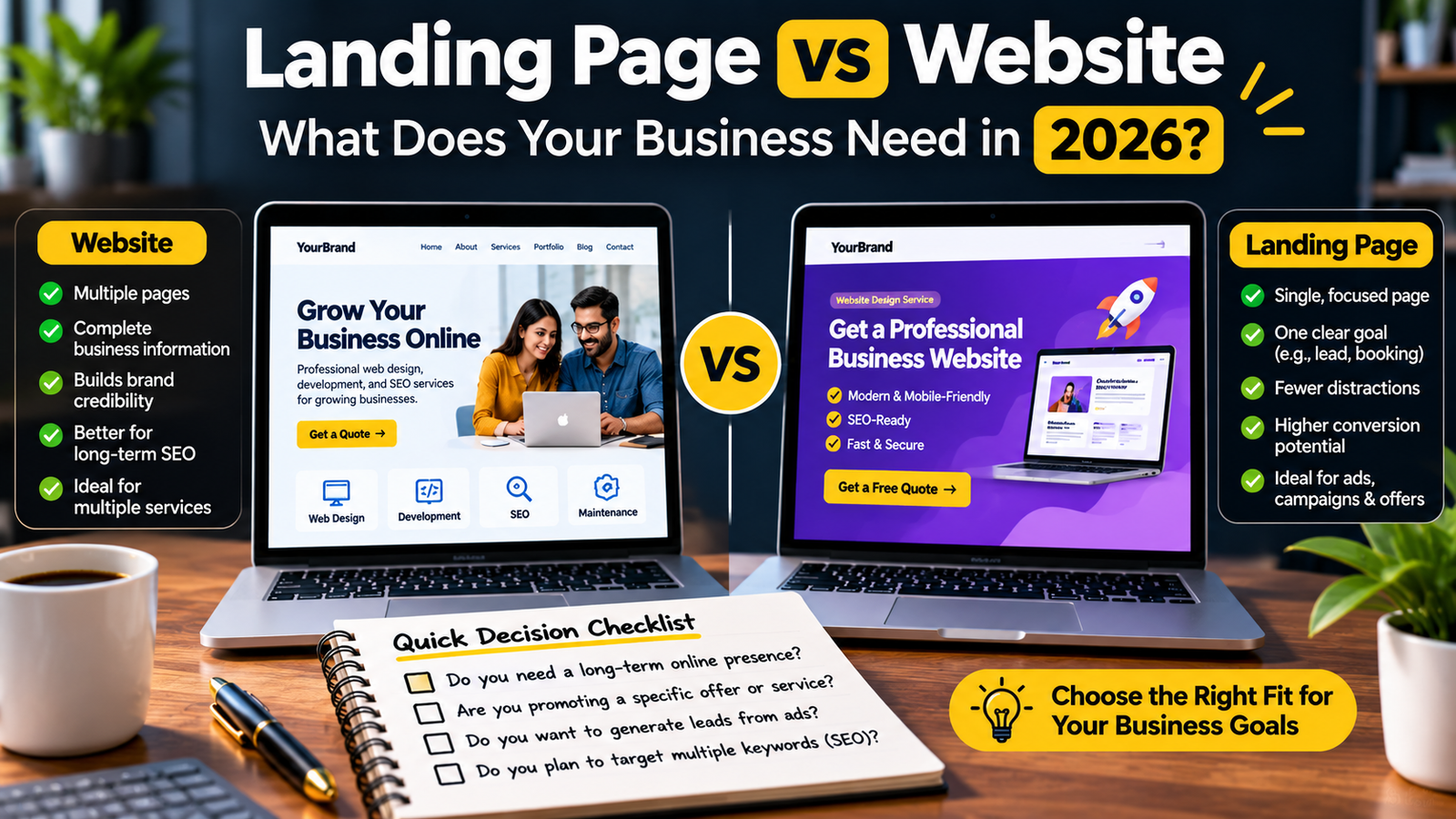
Landing Page vs Website: Key Differences
| Feature | Website | Landing Page |
|---|---|---|
| Main purpose | Present the business | Achieve a specific goal |
| Structure | Multiple connected pages | Usually one focused page |
| Navigation | Multiple navigation options | Limited distractions |
| Content | Broad business information | Specific offer or message |
| SEO | Supports multiple search topics | Targets a focused search or campaign intent |
| Traffic sources | Search, referrals, social, direct | Ads, email, social, campaigns |
| CTAs | Different actions across pages | One primary conversion goal |
| Best for | Long-term online presence | Focused campaigns and offers |
Neither option is automatically better. The right choice depends on what your business needs to accomplish.
1. When Should You Build a Complete Website?
A complete website is usually the better choice when you want to establish a long-term online presence.
Consider building a website if:
Your business offers multiple services.
You want customers to explore your company.
You need individual service pages.
You want to publish blog content.
You want to build organic search visibility.
You need a portfolio or case studies.
You want to establish long-term brand credibility.
For example, a digital marketing agency may need separate pages for SEO, PPC, social media marketing, web development, and content marketing.
A single landing page would make it difficult to explain all these services properly.
2. When Should You Use a Landing Page?
A landing page is useful when you have one specific offer, service, product, or campaign.
Consider a landing page when:
You’re running paid advertising.
You’re promoting a specific service.
You’re launching a new product.
You’re collecting leads.
You’re promoting a limited-time offer.
You’re registering people for an event.
You want visitors to complete one particular action.
For example, a dentist running an advertisement for dental implants may use a dedicated landing page explaining the treatment, benefits, consultation process, and booking options.
The page should answer the visitor’s questions and make the next step clear.
3. Website vs Landing Page for SEO
Search engine optimization is an important consideration when choosing between these options.
A complete website generally provides more opportunities to target different search topics through individual pages.
For example, a web development business could create pages for:
WordPress Website Development
Elementor Website Design
eCommerce Website Development
Website Redesign
Website Maintenance
Website Speed Optimization
Each page can address a different search intent.
A landing page can also attract organic traffic, especially when it provides useful information and matches a specific search intent.
However, creating a landing page doesn’t automatically make it rank in Google.
For SEO, consider these factors:
Search intent
Content quality
Page relevance
Internal linking
Technical performance
Mobile usability
Website authority
Competition
Don’t create dozens of nearly identical landing pages just to target different keywords or locations.
4. Website vs Landing Page for Google Ads
If you’re running Google Ads, landing pages can provide a more relevant experience.
Imagine someone searches for:
“WordPress Website Designer”
If your advertisement promises WordPress development but sends visitors to a general homepage with multiple unrelated services, they may struggle to find the information they need.
A dedicated landing page can provide:
A matching headline
Clear service information
Relevant examples
Pricing or quote information where appropriate
Customer testimonials
A strong call to action
A simple enquiry form
The message in the advertisement, landing page headline, and actual service should match.
A landing page doesn’t guarantee cheaper advertising or more conversions, but it can help create a more relevant customer journey.
5. Which One Is Better for Lead Generation?
Both websites and landing pages can generate leads.
The difference is how they guide visitors.
A complete website may generate leads through multiple pages, including service pages, blog articles, contact pages, and consultation forms.
A landing page focuses on a particular offer and conversion path.
For example:
Website Lead Generation:
Homepage → Service Page → Portfolio → Contact Form → Enquiry
Landing Page Lead Generation:
Advertisement → Landing Page → CTA → Enquiry Form → Lead
The best approach depends on your target audience and marketing strategy.
6. Important Elements of a High-Converting Landing Page
If you decide to build a landing page, focus on the following elements.
Clear Headline
Visitors should immediately understand what you’re offering.
Avoid vague headlines such as:
“Welcome to Our Website.”
Instead, use a specific headline that explains the service or benefit.
Example:
“Professional WordPress Websites for Growing Businesses.”
Supporting Description
Explain what the visitor gets and why the offer is relevant.
Keep the message simple and focused on customer needs.
Strong Call to Action
Use clear action-oriented buttons such as:
Get a Free Quote
Book a Consultation
Request a Callback
Start Your Project
The CTA should match the actual action available.
Trust Signals
Include relevant evidence that helps visitors evaluate your business.
Examples include:
Genuine customer testimonials
Portfolio examples
Professional qualifications
Case studies
Business contact information
Relevant certifications
Never use fabricated testimonials or misleading claims.
Simple Enquiry Form
Ask only for the information you genuinely need at the initial stage.
For example:
Name
Email
Phone Number
Service Required
Project Details
Long forms can create unnecessary friction.
Mobile-Friendly Design
Your landing page should work smoothly on mobile devices.
Check headings, buttons, images, form fields, and page spacing across screen sizes.
7. Important Elements of a Professional Business Website
A business website needs a broader structure.
Consider including these important pages:
Homepage: Introduce your business and explain what you offer.
About Page: Share your business background, experience, and approach.
Services Page: Present your main services.
Individual Service Pages: Explain each service in more detail.
Portfolio: Show relevant projects and examples of your work.
Blog: Publish useful content that answers customer questions.
Contact Page: Make it easy for visitors to reach you.
Privacy Policy: Explain how personal information is handled.
Depending on your business, you may also need terms and conditions, booking pages, product pages, or other specific information.
8. Can a Website Have Multiple Landing Pages?
Absolutely.
In fact, this is often a practical approach for growing businesses.
You can build one main website and create separate landing pages for different services, products, locations, and advertising campaigns.
For example, a web development company might have:
Main Website
WordPress Development Landing Page
Website Redesign Landing Page
eCommerce Development Landing Page
Website Maintenance Landing Page
Each landing page can focus on a specific audience and business objective.
The important thing is to make every page genuinely useful rather than creating duplicate content with slightly different headlines.
9. How Much Does a Landing Page Cost Compared to a Website?
The cost depends on the design, development, functionality, content, and overall project scope.
A simple landing page may require fewer design and development resources than a multi-page business website.
However, a custom landing page with animations, integrations, complex forms, and advanced tracking can also require significant work.
Similarly, a basic business website may be relatively straightforward, while a custom website with many service pages and advanced functionality can be much more complex.
Before comparing prices, check what’s included:
Design and layout
Mobile responsiveness
Content writing
Image optimization
Forms and integrations
SEO setup
Analytics
Conversion tracking
Hosting and maintenance
Compare the complete project scope instead of assuming that every landing page is inexpensive or every website is expensive.
10. Can You Build Both With WordPress and Elementor?
Yes. WordPress and Elementor can be used to build both complete business websites and focused landing pages.
With WordPress, you can create multiple pages, blog posts, service sections, and other content.
Elementor provides visual design tools for building layouts and page sections.
You can use these tools to create:
Business websites
Landing pages
Service pages
Lead-generation pages
Product pages
Portfolio pages
The right setup depends on your design requirements, performance needs, plugin choices, and website functionality.
Remember that using a page builder doesn’t automatically guarantee good performance. Optimize images, avoid unnecessary plugins, and test the finished website.
11. Common Mistakes to Avoid
Whether you’re building a website or a landing page, avoid these common mistakes.
Using the homepage for every advertisement: Visitors may not find the specific service they expected.
Too many CTAs: Multiple competing actions can confuse visitors.
Weak headlines: Visitors should understand the offer quickly.
Poor mobile design: A desktop-friendly page may still be difficult to use on phones.
Missing trust signals: Customers need useful information to evaluate your business.
Slow loading: Heavy images, unnecessary scripts, and poor hosting can affect performance.
Ignoring SEO: Important pages should have useful content, appropriate metadata, and clear structure.
No conversion tracking: Without measurement, you may not understand which pages generate enquiries.
12. How to Choose the Right Option for Your Business
Use your business goals to make the decision.
| Your Business Goal | Recommended Approach |
|---|---|
| Establish an online presence | Complete website |
| Promote one specific service | Landing page |
| Build long-term organic visibility | Complete website with service pages |
| Run a focused advertising campaign | Dedicated landing page |
| Showcase multiple services | Complete website |
| Collect leads for one offer | Landing page |
| Sell multiple products | eCommerce website |
| Build brand authority | Complete website with useful content |
For many small businesses, the strongest long-term approach is to build a professional website first and then create dedicated landing pages when specific marketing needs arise.
Final Thoughts
A landing page and a complete website serve different purposes.
A website gives your business a broader online presence, helps visitors explore your services, and provides room for long-term content and SEO growth.
A landing page focuses on a particular offer and guides visitors toward one primary action.
You don’t always have to choose between them.
Start with the solution that matches your current business goals. As your marketing grows, you can combine a complete website with focused landing pages for different services and campaigns.
The best website strategy isn’t about choosing the most complicated design. It’s about creating the right experience for the people you want to reach.